The Tyranny of Couches

Today I will share the tiniest slice of my brainmeats with you. I’m in the middle of packing for the big move, editing the first draft of the fourth book of the Warpworld series, trying to come up with funny and clever dialogue for another writing collaboration, and cursing my singularly stubborn stuffed sinuses.

We move a lot. If you’ve followed these Coconut Chronicles for even a year you already know that. It can get tiring, at times, all this moving. Packing, unpacking, packing, unpacking, et cetera. It can also be enlightening and inspiring.

Remember the horrible couch?

Well, we finally unloaded that abomination. Except the new-ish couch wouldn’t fit through the awkward narrow door/hallway here. There were some frustrated tears and then we dragged out the other not-comfortable couch from the back room. That is what we have been sitting on ever since.

Sitting on and complaining about and vowing to get a more better couch after we moved.

On Sunday we had a small garage sale to rid ourselves of extraneous goods.

“Want to sell the couch?” Prez asked.

“Sure,” I said.

We sold it. We were couchless. It would be four weeks until we left Nelson and we had nothing to sit on.

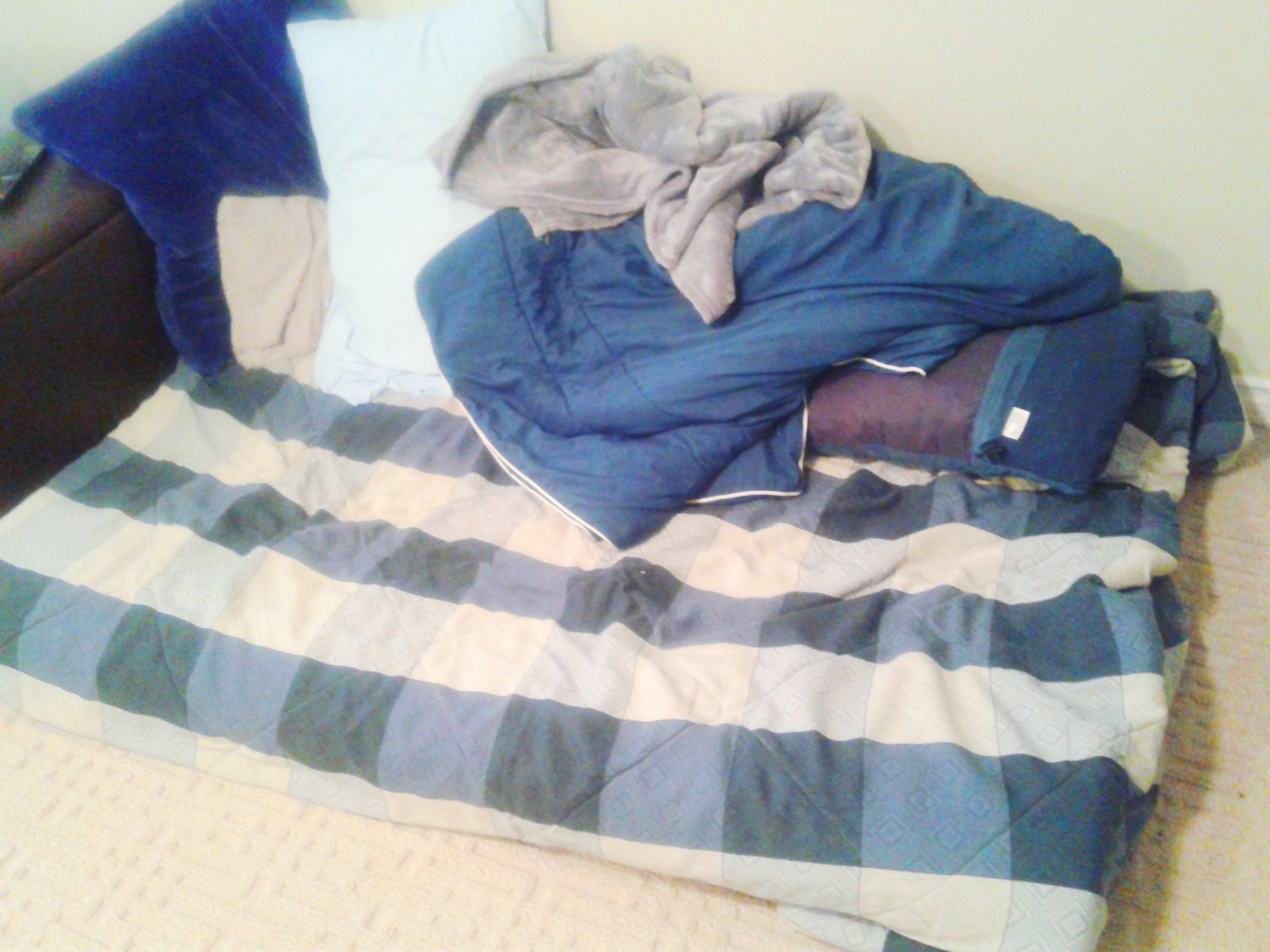
Ever resourceful, we dragged a piece of high density foam out to the living room, covered it with an old comforter and tossed some pillows and other blankets on top. Viola, couch!

Kristene Perron's new couch

This is the new couch

Guess what? It’s really comfy!

All this time we have put up with back pain and ugly clocks and wayward cushions because of what a couch is “supposed” to be. I mean, what would people think if they came to our home and saw that our living room furniture consisted of a piece of foam and some blankets?

Except why do we care about that? Because our society says we must have a couch does that mean we MUST HAVE A COUCH? What about other cultures that are perfectly happy sitting on the floor? On cushions? With blankets?

This is what the nomad lifestyle, with all its annoyances and uncertainties, does for me. It reminds me that everything is a construct. Free will is a gift. We have more choices than we know. And sometimes all it takes is the will to say, “I do not need a couch.”

Posted in Humour and satire, Travel | Tagged , , , | Leave a comment

All That I Do Not Know

shelf full of books

And so I return from WorldCon, awash in the glow of camaraderie and inspiration, with the lingering scent of stale gin. There were all the usual Breakfast Squad shenanigans, interesting panels, and of course the Hugo drama. I’ll save the newsy wrap up and my profuse thanks to the Consortium of Ridiculously Kind Persons for a Facebook post later, what I want to talk about now is one of the less pleasant feelings that hits me—and I suspect some others—at SFF cons: inadequacy.

I adore speculative fiction of all stripes–fantasy, horror, science fiction, and all of their many sub-genres. If there are ten great movies playing at a theater (sadly, never a reality), I will always choose the science fiction flick first. I’ve watched every episode of the Firefly series about thirty times. I grew up playing Star Wars with my neighbourhood chums, I owned a massive comic book collection by the time I was nineteen, and I would go on to perform stunts on shows such as Stargate, Andromeda, and X-Files. In fact, I have a photo of myself and William Gibson who co-wrote the X-Files episode “Kill Switch”, which I appeared in as “Kung Fu Nurse”, (he also wrote a little book called Neuromancer). Oh, and I also have three published SF novels out in the world.

Pretty strong geek cred, no?

No.

At every con I attend, I am floored by how much I don’t know about, well, everything. Everywhere I turn people are talking about books I’ve never read, authors I’ve never heard of, and famous figures within the SFF community whose names mean nothing to me. With each new interaction, I feel myself shrink inside my own skin. Why am I even here?

At the panels and talks, it gets worse. Many of the speakers are walking encyclopedias whose knowledge spreads well beyond the boundaries of SFF fandom. Not only do I not know enough about this thing I supposedly love but I am also a dunce when it comes to science, economics, linguistics, art, history, and on it goes.

Sitting in a talk about macro evolution, I felt pretty good that I was able to grasp the ideas being put before me. Then it was time for audience questions. Oh Cod, the questions. Where I had understood the talk well enough to summarize the basic premise, these other people had questions that showed a level of understanding that made me look like a chimp banging a rock against the ground. Or perhaps against her own head.

It is easy, too easy, to walk away from these events feeling stupid and small. Too easy to get defensive, to slam the doors shut on the joy of learning and embrace the familiar well-worn paths of the past. But that way lies despair and stagnation.

*

I joined a running club in 1995 with the goal of one day running a marathon. I had tried running on my own and hated it. There was a circuit my friend and I used to run in his neighbourhood that took us about twenty-five minutes to complete and always left me feeling breathless and sick. I couldn’t imagine running for twenty-six miles but I signed up with the club and soon found myself trudging along with a gaggle of other better, faster, more experienced runners.

This was no movie training montage. Every run was pain and frustration. I was the slowest in the pack, lagging well behind people twice my age. I didn’t give up because I have this weird little stubborn switch in my body that demands I not quit. The leader of the group told me that if I wanted to run fast, first I had to run far. Yet, after months of training, I felt as if I was no further ahead than the day I’d started. How would I ever run a marathon?

One day the regular club run was cancelled and so my friend and I decided to run our old route, just the two of us. Not long into that run, I was amazed at my speed and endurance. Hills that had always been a grind were easy and I finished well ahead of the old twenty-five minute mark, ready to keep going. No pain, no sickness, only elation. Somehow, without even realizing, I’d improved.

How had that happened? One mile at a time.

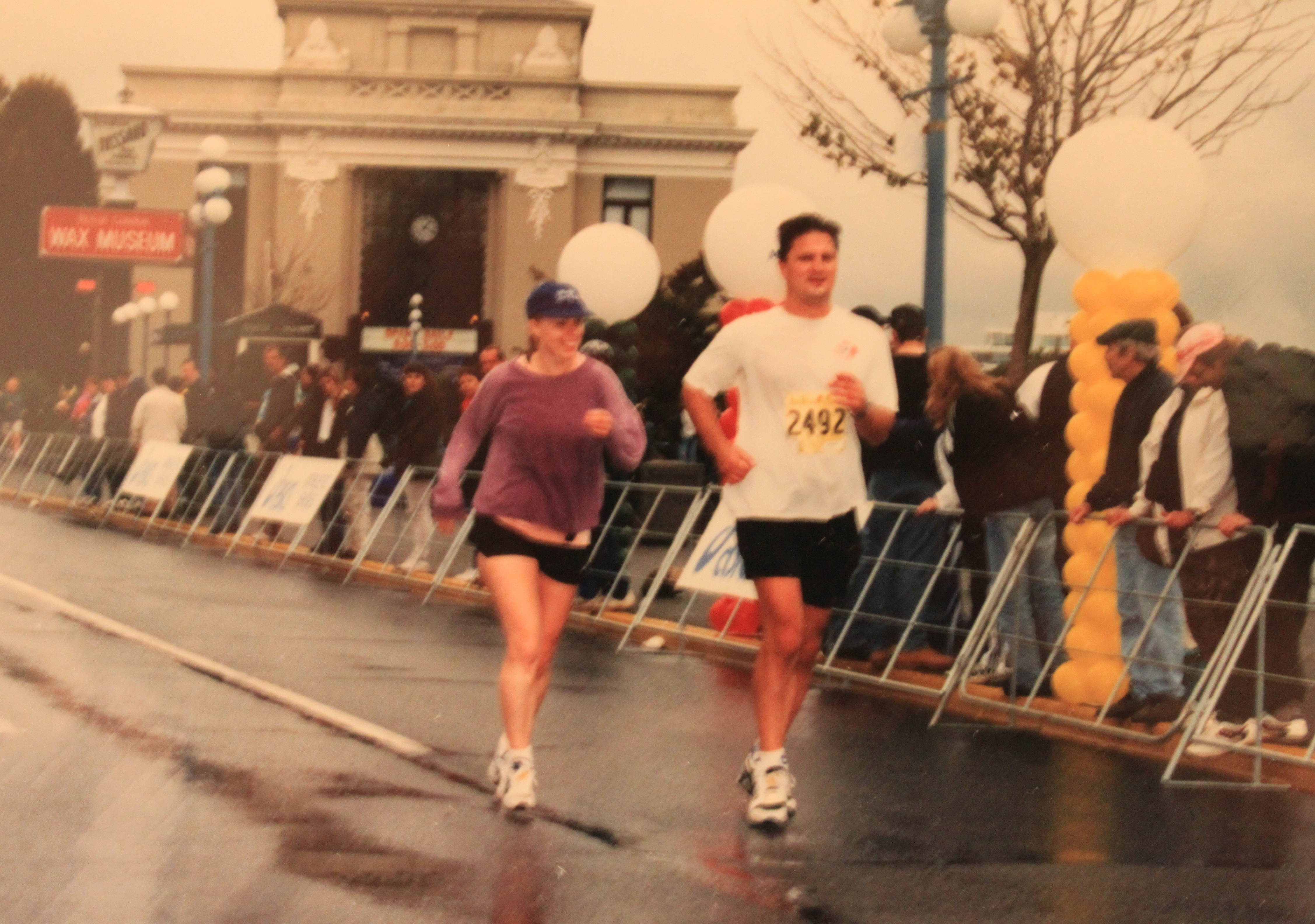
In 1997 I ran the Victoria Marathon. I was slow and I had to rest for a week afterward but I did it. I would go on to join a triathlon club and compete in my first triathlon three years later. I still run regularly. When I’m at my best, I run six miles every other day at a decent pace.

Kristene Perron running in the Victoria Marathon

Running the Victoria Marathon. Soggy but happy.

*

I turned forty-six this July. Some days I hear the clock ticking loudly, reminding me of the finite amount of time I have left and all the things I still haven’t learned or done. It ticks loudly at SFF cons, in the face of all that I do not know and possibly never will know.

It is not easy to tune out the ticking, but I do.

My life has been full of marathons—tasks I believed impossible and then went on to complete. Not only that, but my life has also been full of adventures most people only dream of. I may not know the taxonomy of a bronze whaler shark but I know what it feels like to see one swimming ten feet below you in the open Pacific Ocean. It is too easy to see our own knowledge and accomplishments as small in the face of others.

However difficult it may be in the immediate moment, I choose to focus on what I can learn—no matter how insignificant—instead of all that I do not know. I choose to humbly admit my lack of experience and knowledge, to keep the doors open wide. I dream of the day I will be the one at the front of the room at a big SFF con, talking about my areas of expertise.

When that day comes, to the person in the audience feeling inadequate, please remember that I got there the only way you can get there: one mile at a time.

Posted in Entertainment, On Scribbling | Tagged , , , , | 1 Comment

Trusting the Earth to Hold You Up

Saying goodbye to Dad

Yoga is hard.

Make all the jokes you want—and I’ve made plenty since I moved to Hippie Heaven, Nelson, BC—a good yoga class is a bonafide workout in every sense of the word. I have not done a lot of yoga over the years but several weeks ago I let my friend Dana drag me out to a local class that mixes yoga and Pilates because I know that the two things I need to do most these days are core strength exercises and stretching. Welcome to middle age, ladies and gentlemen.

The class was tough, the instructor was knowledgeable and friendly, and the hour-and-a-half session ended with some deep and much-needed relaxation.

When I returned to Nelson after my Dad’s death and the nightmarish weeks that followed, I was eager to get back to my fitness routine. My physical and mental well being are so closely joined that I can’t consider one without the other. Tuesday, spin class; Wednesday, yoga; Thursday, TRX—that’s the current schedule, (hopefully with short runs to be added in again soon).

Wednesday night yoga rolled around and it felt good (and painful) to be back on the mat, lengthening and strengthening. Aside from one hilariously failed attempt at Crow Pose, I was confident and happy. Then we all lay on our mats, on our backs, closed our eyes and listened as the instructor guided us through full body relaxation, beginning with breath and then moving to consciously relaxing from the head down.

“Relax your forehead, feel your eyebrows rise and spread apart.”

I relaxed my eyebrows. Huh, who knew eyebrows could be tense?

“Relax your face, let your jaw go loose, let your mouth fall open.”

So glad no one videos this part of the class.

“Feel the back of your body against the floor, feel it sinking into the floor, trusting the earth to hold you up.”

My slack jaw tensed.

“Think of what you would like to let go of.”

I forget the exact words that came next. What I remember is that feeling, that tightening around the base of my neck, the warning signs that it was coming. Again. Still. I was going to cry.

Damn it. I was so tired of tears.

How could I trust the earth to hold me up when it had dropped me twice in less than two months?

A few tears slipped out, tracing hot streams down the sides of my face before I could shut the spillways. I didn’t wipe them away. If I believed in an afterlife, believed that my sister was somewhere looking down on me, there is no doubt that she would have been savoring the irony of her stoic, tear-free younger sibling fighting to keep from dissolving into a puddle in the middle of a room full of Lulu Lemon-clad mostly-strangers. For Kelly, I left my face untouched.

For me, that was a big deal. A colossal, holy-cow-am-I-really-doing-this deal.

I am a private crier. No matter how sad I am the floodgates slam shut at the sight of even one other human. Even when that person is my husband, the most trusted and loved person in my life. I’ve tried, with varying levels of success, to change this habit. Not that I want to blubber shamelessly wherever I am and whoever I’m with, but now and then wouldn’t be so terrible.

Worst of all, sometimes when I’m right at the edge of public tears, my body flips a switch and changes them to laughter—weird, awkward, hideous laughter.

Back in April, sitting with two of my dearest friends, I related a moment I had spent with my sister that had crushed me. I looked out at my kind, compassionate, long-time friends as I spoke, knowing that I was completely safe to let the welling tears flow…and out it came.

“It’s fucking awful,” I said, laughing the hideous laugh and hating myself.

I’ve often worried that my friends and family must think I’m made of granite or that I don’t love or trust them enough to share my sadness. How weird must it be for them to read these Chronicles, with me spilling my deepest and most shameful feelings on a regular basis, and then to sit across from me in person as I relate the story of my sister and dad’s death, dry-eyed and in a matter-of-fact tone? If I told them, in that moment, that every word was like razors in my gut, would they believe me? How could they?

In the past six months, I have cried more, and more violently, than I have in the past sixteen years. Ninety-five percent of those tears have been cried privately—in the car, in my room, in the shower, in a tent. Because of this, I have imagined that my friends and family could not possibly grasp how desperately I have been clinging to their kindness, how a single word of sympathy has had the power to keep me moving forward.

Then Monday happened.

After I announced that I wouldn’t be attending Worldcon this year for financial reasons—and being okay with that decision—a few friends offered to help me out. I declined. I had not made that decision public with the intent of gaining sympathy or with the expectation that someone should come to my rescue. It’s just a convention, for goodness sake, it’s not like I need a kidney or something.

Then a few more friends offered.

I declined.

Then a few more.

“You are too sweet. I’ve had a few offers of help but I really can’t accept. If I had a manuscript to pitch or something, I might say yes but letting other people pay for my fun I just can’t live with,” I said.

Then my friend, neighbour, fellow writer, and amazing human being Deryn Collier, speaking on behalf of what I now call the Consortium of Ridiculously Kind Persons, wrote this to me:

But if it came freely and with no strings attached. Like cash out of the sky. Could you then? Because your steam all got used up on serious family stuff, and maybe your friends want to help out with some fun. What if it is our way of showing we love you and believe in you and want to support you? What about that?

What about that? What if I was wrong and despite my lack of public waterworks my friends truly could see how wounded I was?

“What’s wrong?” Prez asked, at the sight of me slack jawed and weeping in front of my laptop.

I explained. After some discussion with Prez, I relented. What happened next was overwhelming.

Friends Wendy Kelly and Anthony Sanna led the charge with a Facebook post of unparalleled awesomeness. Soon, online donations were popping up in my inbox, people were messaging me with other offers of help and support, my good friend Helen Lutz donated her car for my use, and everywhere I turned there were words of love and support and appreciation.

I spent the next forty-eight hours alternating between tears and laughter.

Today, Wendy dropped off a pile of cash donations, which she had collected in an oh-so-appropriate Star Trek lunch box. I hugged her. Three times. Maybe four. There weren’t tears but not because I was holding them back, simply because for the first time in weeks I felt good, happy, at peace.

Star Trek Lunch box with donations

The collection box

Wednesday morning I will depart for Spokane, Washington with a smile bought and paid for by the Consortium of Ridiculously Kind Persons.

So there I was in yoga class—yes, we’re back there—eyes closed, face wet from those rebel tears. I thought about the earth that had grown so unsteady beneath my feet since the day my sister first went into the hospital. No, I could not trust the earth to hold me up. Not now. Not yet. Maybe never.

But when the earth lets me fall, I can trust my friends, my family, and my community to pick me up. Long after Worldcon has come and gone, that is the gift they have given me and that is a gift that will last forever.

Thank you all.

Namaste.

Posted in Family & Children, Friends, Health and wellness, Love, On Scribbling | Tagged , , , , | 7 Comments

Wherein I Become Financially Responsible

close up view of cash money dollars bills in amount

I’m officially nominating myself for the “Things Can’t Possibly Get Worse…Oh, Wait, They Can” award. Though I expect stiff competition from Greece, Syria and Nepal, I think I have a good chance in the “Oh, the irony” category.

Irony #1: Prez and I have been talking about a move to Vancouver Island for a few years now. Most of our family and some of our friends live there, we love and miss the ocean, and we could rent an entire house in Campbell River for not much more than we are paying for a basement suite in rentally-challenged Nelson. When my sister died, that sealed it. She had been my dad’s main support system and now he was alone. I needed to be close to my dad. I called him with the good news; he was thrilled.

And you know how that story ends. Well, almost.

Let’s talk about money.

My relationship with money is complex. I have always been a hard worker—I found my first real, non-babysitting job at the age of 14 and have worked steadily ever since—but I have never been a good saver. I’m sure there are reasons for this. With enough money and time, I’m sure a psychologist could enlighten me. Whatever the reason, I suck at rainy day preparation.

Over the years I have been various levels of poor and wealthy. There were the starving student days, of course. But even when you and your two roommates are sharing a quarter of a raw cauliflower and rationing the dregs of some cheap white wine for dinner, you can laugh about it. Hey, you’re young, you have years and years ahead to make money and everyone around you is in the same boat.

Time erases the laughter. There is nothing hilarious about calling your alcoholic soon-to-be-officially-ex-husband to beg for $100 so that you can buy enough groceries to make it until payday. And when he taunts and ridicules you and eventually says, “No”? Yeah, that kind of poor is smile-free.

Then there were the days of jetskis and dirtbikes, new trucks, my own condo, months spent at Prez and my’s beach house in Baja, inviting six friends out for dinner and picking up the tab without blinking, last minute trips to Vegas, and so on. Heady times, indeed.

These days I hover a fair distance above “starving student” (no cauliflower, thanks) but far below “Jetskis and Dirtbikes”.

I am still bad at saving.

More than sex, money is an embarrassing topic to discuss publicly. Even as I write this I am cautiously editing myself for Prez’s sake. I’ve had quiet conversations with friends about our mutual struggles but always one-on-one and with the implicit understanding that this information is not to be shared. I can tell you, without naming names, that a lot of us—even those you might least expect—are having a hard time. Debt is rampant and even people with good paying jobs and modest lifestyles are frantically treading water. Many of us are one minor tragedy away from financial ruin and/or bankruptcy. Yet, we stay silent. Why?

There’s a real stigma to being bad with money. In our parent’s day, you got a job, you worked hard, you moved up the ranks, your loyalty was rewarded, you saved, you bought a house, had kids, took two weeks vacation per year, and could expect to have enough money to live comfortably in your retirement. (Especially since you’d likely die within ten to fifteen years). In our parents’ day, though, the cost of living was reasonable and you could expect to work for the same company your entire life and leave with a tidy pension.

Times have changed but our thinking hasn’t. If we’re not doing as well as the past generation, we consider ourselves failures. It doesn’t matter if our parents would have struggled just as mightily in this age of extreme financial uncertainty, there is a pervasive sense that, no matter the size and number of the obstacles, we should be doing better than we are.

Now, I can’t blame all of my money woes on external factors. Have I mentioned I’m a bad saver? I also have a high risk tolerance—great for life as a stunt woman, not great for a middle aged person planning for the future. Add to that: my gypsy tendencies, a leaning toward conflict avoidance, my decision to indie publish, and a host of other character traits and bad decisions that all help to keep me in the red.

I suck at money.

Which brings me back to the irony I spoke of at the beginning of this ramble.

Since attending my first SF/F convention in 2012, (Worldcon, in San Antonio, Texas), I’ve been hooked. Cons are fun, they are a great way to meet other people in the industry, they are the best place to learn about what’s what and who’s who in the business of publishing, and they are where my tribe lives. Cons are also expensive for me. Because Prez and I choose to live off the beaten path, getting to a con usually involves at least a day or more of travel and lots of associated travel fees.

When I learned Worldcon was going to be held in Spokane, Washington in 2015 I was ecstatic. At last, a con close to home! A mere three hour drive would take me there and if I could find a roomie then this would be my most affordable con ever!

Since saying goodbye at the last con, I have been eagerly awaiting the end of August, when I would reconnect with my fellow nerds once more.

Then my sister got sick. Trips to Vancouver, weeks spent with her in the hospital, not working, charges on the ol’ Visa. Then my sister died. Last minute flights to the island, weeks spent planning and preparing her memorial, more charges and expenses. Then the decision to move to the island, which meant even more expenses (a U-Haul trailer will cost us $600!). Then my dad…more last minute flights, more expenses, more time not working. Deeper into the red.

I arrived back home in Nelson on August 7th, exhausted and sad. I looked at the calendar I keep on the wall. Worldcon is highlighted in a once-cheerful shade of red.

Irony #2: This was the closest a big con would be to me and the smallest travel expenses I would ever have…and it couldn’t have happened at a worse time.

I had a decision to make.

Not just a decision about a convention but about how I’m going to live my life from this point forward. Either Prez and I go on as we always have—hitting the road for adventures when the mood strikes and living day-to-day—and accept the stress that comes with debt and financial insecurity as the cost of being nomads, or we choose a different path and fight our way back to black.

“I can’t go,” I told myself.

I want to go. I really, really, really want to go to Worldcon, and it burns me to know how close it is this year, but I need to pay for the costs of my family tragedies. More than that, I need to make myself into a good saver.

Monday morning I will call and cancel my hotel reservation and put my Worldcon membership up for sale. I’ll have a little pity party for myself as I pack for the upcoming move but there will be some pride in there too. Doing the right thing feels good even when it doesn’t feel good.

So, yes, things can always get worse but sometimes they have to get worse before they can get better.

Posted in Friends, Health and wellness, Life at Work | Tagged , , , | 2 Comments

That Day I Went Crazy

I threw eggs into the forest today.

My dad died from complications of pneumonia on July 25th, forty-seven days after my sister died. I think I’m in shock though it feels deeper and stranger than that.

Robert—“Bob”—Marrington was born on August 29th, 1933, one of eight children in a poor family, though I suppose most families were poor at that time. You can always tell the people who lived through the Depression, they don’t throw anything away. In the kitchen of my childhood, on the windowsill over the sink, there was a collection of plastic bread bag fasteners. Why? What did we use them for? Nothing. But they were useful items that could seal a plastic bag and so they had to be saved.

When my sister was first admitted to the leukemia ward of Vancouver General Hospital, we had long conversations about the future because we believed there would be one that included both of us. We bemoaned our elderly father’s junk collecting tendencies and shivered at the thought of what we would have to sort through when he died. Dad was not in the best of health—diabetic, arthritic, suffering from COPD and a bad knee and tinnitus and so much more—and we had to be realistic.

“When you’re out of here, we should plan a week and go through all his stuff and have a garage sale,” I said.

Kelly agreed. It was going to be good for him and us. We were excited about the prospect of unburdening our father. It would be joyful work, digging up memories together.

Then she died.

Dad had never been a fool. He sat me down and said, “I won’t be around long, babe. I always thought Kelly would look after everything when I’m gone but now it’s all on you.”

I always thought it would be Kelly and me looking after everything.

Who am I kidding? I would have helped but my responsible older sister would have taken on the lion’s share of the work.

“You’re going to have a hell of a mess to deal with,” Dad said. Then he showed me his will, with Kelly and me named as co-executors. He told me that he wanted to be cremated and have his ashes put in with my mom, who was buried on the mainland. He said he should have weeded through his many possessions years ago and apologized for not doing so.

“I’ll be back in September,” I told him. “I’ll help you clean out everything and we’ll have a big garage sale and make some money for you for Bingo.”

He seemed enthused by the prospect. Or maybe that’s what I wanted to believe.

Then he died.

The next day I drove to his rental place to get the will and some other paperwork…and to be close to him again. I pulled up the driveway and shattered into a thousand pieces. The sounds that came from my body were not human. I cried so hard I nearly passed out.

I knew this day was coming but it wasn’t supposed to be like this. It was supposed to be me and my sister consoling each other, crying and laughing together. I wasn’t supposed to be alone. Mom, Dad, Kelly—all gone. And though I knew that I had an amazing husband, in-laws I loved, my half sisters and brother reunited with me at long last, and more friends than I deserved, in that moment I was not only alone, I was an orphan.

My family is no more. I am the last of us. I alone carry all of our memories and they are too heavy.

*

At the end of his life, my dad resided on a piece of rental property slightly off the beaten path in Coombs, BC. Through a series of disasters—none of his doing—he was virtually penniless, relying on his meager pension to survive. The trailer and its add-on living area was a step above squalor but the setting was pastoral and peaceful. Dad could have a big garden and there were four storage sheds for all his “treasures”.

Dad’s Depression era thinking proved a boon on a fixed income and because of his deteriorating health he could not do much more than watch TV, putter in his garden, clip coupons, and make it out to Bingo a few times a week with my sister.

Kelly was his companion, his caretaker, his drill sergeant. I was always the gypsy child, coming and going and never staying long. Whenever I came to visit, I cringed at what he had been reduced to and berated myself for not being smarter with my own finances and, thus, not being able to help him. If he felt the same, he never showed it. Always so happy to see me, to steal a few moments of my time. He would sit in his brown La-Z Boy and tell me the same stories he told me every visit and I would laugh like I’d never heard them before. He would ask when my books were going to get made into movies so he could buy that yacht he wanted.

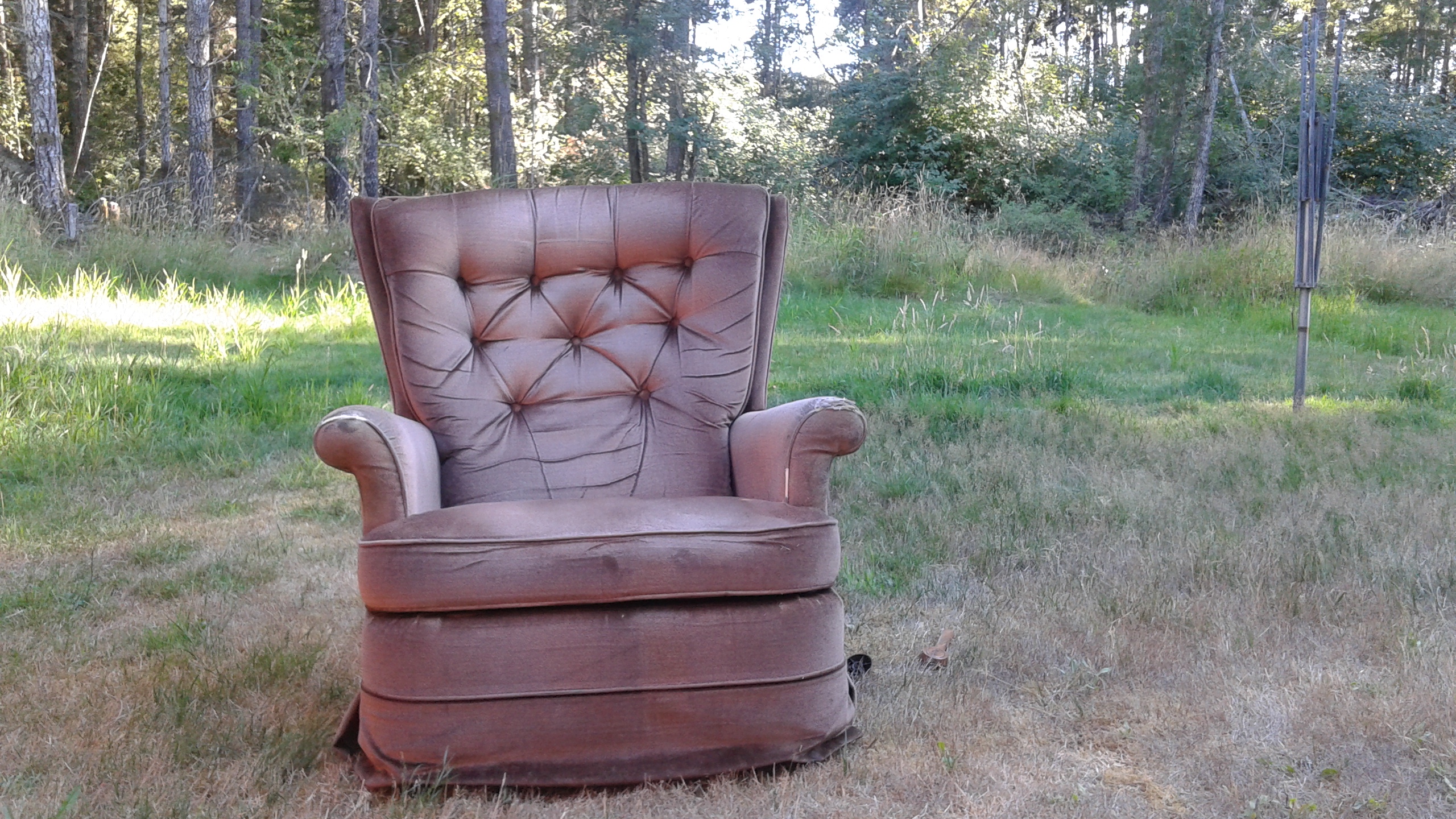
That brown La-Z Boy recliner was the center of his small universe. That was where the paramedics found him when they came to take him away to the hospital for the last time.

The day after he died, standing in his living room, all I could think of was how empty that chair was. I would never see my dad in his chair ever again.

The next day, knee deep in the job I’d dreaded, I dragged that chair out of the house so I didn’t have to look at it.

But he was still sitting there, watching me paw through his treasures, throwing out perfectly good bags of old elastics and being generally wasteful.

On the third day—today—I cleaned out the fridge. Jars and juice boxes went into the industrial garbage bag, milk containers went into the recycling bin, organics got dumped into the forest at the back of the property.

It was the eggs that stopped me. I carried the mostly-full carton to the treeline, preparing to simply toss them all, when I was seized with an urge. The brown chair was behind me. I felt my dad there. Each egg was, for him, a meal. More than a week of breakfasts. And here I was just throwing away perfectly good food.

I didn’t care. If my dad couldn’t eat these eggs, then I didn’t want anyone to eat them.

I picked one out of the carton, cocked my arm, and launched it into the forest. It hit a tree with a satisfying crack and yolk flew. I picked out another and did the same.

“Oh, you think that’s funny?” I said to Dad, in his chair. I threw another one.

I laughed. We laughed. I started to cry while I laughed.

“Why did you all leave me?”

I threw another egg and screamed.

I screamed and laughed and cried and threw every egg until the carton was empty.

And then I went back inside and kept cleaning.

Tomorrow, he’ll be waiting for me, in that chair and, now and then, when the weight of the memories gets too much, I will sit with him and we’ll laugh about that time I went crazy and threw eggs into the forest.

Robert Marrington's brown chair

Posted in Grief and Mourning | 8 Comments

The Time It Takes

Sand passing through the glass bulbs of an hourglass measuring the passing time as it counts down to a deadline or closure on a yellow background with copyspace

Josh and I are approaching the end of the first draft of our fourth Warpworld novel. With each new installment, our process is refined and our efficiency improves. I anticipate a final draft, ready for publication, in early 2016. My guess is that we’ll come in around 200K words again.

Five years ago, a manuscript of this size and scope would have taken us two years or more to produce. Now, I feel confident that we can put out a polished, pro-quality, six-hundred page book in one year, every year.

Why? Where did the improvement come from?

Well, to quote my author friend Mark Nykanen’s words to me, “I’m not sure I’m a better writer but I’m definitely a better editor.”

(For the record, Mark’s average daily word count is mind boggling. I am no Mark Nykanen.)

Better editing may be an oversimplification, there are a number of factors that sped production after that first book hit the shelves, but, yes, I’m a better editor now. I’m correcting mistakes before I even type the words. I have a firmer grasp on the basics of story construction—pacing, POV, voice, character arcs, etc. I’ve learned to divorce myself from those infamous “darlings” and only consider what best serves the story.

I outline.

No, let me repeat that…

I OUTLINE. Pantsing is fine and well but when you’re writing with a partner it pays to have at least the roughest of road maps to direct you. Guaranteed, at least once per manuscript Josh and I will hit a point where we have drastically different ideas about a major plot point. Fixing this in the outlining stage is no biggie—a few hours of arguing each of our cases, followed by a compromise of some sort, followed by a lot of “I still love you!”s. Easy peasy. Fixing this while you are hip deep in a draft can be a nightmare, sometimes necessitating pages and pages of rewrites.

Outlines, contrary to what I once believed, do not stifle creativity. Josh and I still veer away from our outlined scenes on a regular basis. Outlines are merely markers in the fog, designed to keep you from losing your way and accidentally driving off a cliff.

Shameless plug: If you’re struggling with outlining or you’ve never done it, may I highly recommend Mark Teppo’s new book Jumpstart Your Novel. I did an outlining workshop with Mark and in 90 minutes I had an almost-complete outline for a new manuscript.

Faster? Yes, we are faster but this is not me bragging. I still consider myself a slow writer and compared to many in the indie publishing world my pace is positively glacial.

What I want to say is that I’m okay with this. I wasn’t always okay with this.

My long-suffering writing partner can tell you horror stories of me frantically demanding more! Faster! Now! Hurry!

I was late to professional writing and every day I was falling further behind the pack. All those brilliant twenty-somethings had a head start I couldn’t begin to catch up to and so I needed to compensate with speed and productivity.

And then…Cod help me…I started researching the world of the indie author. You need to publish two books a year! Three! Five! Six! And short stories! And blog! And tweet! And attend conferences! And cure cancer! And…

Falling further behind.

My nerves were frayed. How was I ever going to catch up?

Two things stopped my manic descent into writing hell.

1. Josh. He’s the yin to my yang. The goat to my thoroughbred. The speed limit on my Autobahn. Every hyper overachiever needs a Josh. As much as I know he appreciates my perkiness and enthusiasm (though he may never publicly admit to this), I also appreciate his ability to slow down, stop worrying, and just enjoy the ride

2. Pudding. As in, “the proof is in the”. In the spirit of unity, and research, I picked up a few books by some of the more well known and prolific indie authors. These were novels penned in a quarter of the time it takes Josh and I to complete a manuscript. Guess what? It showed. I’m not asserting that we are literary geniuses but what I read was mostly sizzle and very little steak. (This paragraph is making me hungry). In every case I had to put the book down less than a quarter of the way into the story because the plot was too predictable or lacked plausibility, the characters were flat or uninteresting, and/or the writing quality was rough enough to distract from the story.

I had a choice to make. I could write super fast, leave out all the tiny details that I love, concentrate on marketability over story, and lose my sanity (and perhaps my co-writer, friends, and husband), in the process or I could slow the hell down and take the time it takes to write the stories I want to write.

You can probably guess that I chose the latter.

There are times I love speed; writing stories is not one of those times.

Kristene Perron standing next to a race car

This is a place I like to go fast.

This is not me patting myself on the back, either. Those fast, prolific indie authors are making a hell of a lot more green than I am. They have a firmer grasp of the business of publishing than I do, without question. But I chose my path not so long ago, I chose love over money.

I wrote this post because maybe there’s a new writer out there feeling just as I did six years ago. Feeling slow, feeling inadequate, feeling as if they will never “catch up”. Listen carefully: Stop. Breathe. Think.

This is not a race. Ask yourself: “Why am I writing?”

If you want to make buckets of money as an indie author, then, yes, you will likely have to keep up the frantic pace and you will have to write marketable books. (Among many other things, but we’re talking about speed here). If you’re taking the trad publishing route, you’ll still need to meet deadlines but they likely won’t be as intense. In either case, honing your craft and learning to become a better self-editor takes time and practice. There is no magic pill, no webinar or book that will instantly drop that knowledge into your brain.

If you want to write damn good stories, the kind that feel like a dive in the ocean and not a jet boat ride across the surface of a lake, then those books take the time they take.

It’s that simple and that complex. A book every six years probably won’t make you much money these days (George RR Martin aside), but if the book you want and need to write takes six years, well, that’s the time it takes. If you can write a heartbreaking work of staggering genius (copyright Dave Eggers) in three months, more power to you.

And never forget that if money is your goal, there are easier ways to make it than as an author. Many, many, many, many easier ways. Presumably you choose to write because you enjoy it. Because even when you’re smashing your face against the keyboard in frustration, there is nothing else you would rather be doing than making stories. If it stops being fun, if your focus is no longer on plot and characters and metaphors and all the fun things writers get to play with, and is now directed solely on writing faster, faster, faster, then what’s the point?

If you love writing faster, faster, faster and you are reading this while sitting on stacks of hundred dollar bills, then there’s no point in reading any more of this blog.

Everyone’s process is unique and yours is not wrong if it is slower than what you think it should be. That doesn’t excuse you from sitting your ass in the chair, by the way. Butt goes in chair, end of story. Literally. You can’t finish a story if you don’t sit your ass in the chair and write it!

One final word on the time it takes to write a good story.

About a month ago I learned that I was a Writers of the Future finalist for a short story I’d submitted to the competition. This is a pretty big deal in the SF/F writing world and I was flattered and thrilled. (I still am). That story was about 6000 words. I spent months researching and even more months letting the story percolate before I even began to type. 6000 words, all told, took over a year to go from Idea Seed to Finished Story. That puts my average word count at .06 words per day. Pretty crappy, huh? While I didn’t hope to make it all the way to Finalist, I don’t think it’s an accident that my slowly written story ended up there. I took the time I needed to tell the story how it needed to be told.

Here’s your tl;dr: Slow down if you need to slow down. If you feel you need someone’s permission to do this, consider mine granted.

p.s. You don’t need anyone’s permission.

Posted in Indie publishing, On Scribbling | Tagged , , , , , | 3 Comments

Giving Bathing Suit Season the Finger

Mother swimming with infant underwater

Summer = swimming. That’s the equation that could sum up most of my childhood summer vacations. Whether splashing around in my backyard above-ground pool with my friends, zipping down a water slide, or diving into one of my province’s bounty of lakes, all I wanted every day, all day, was to swim.

My dad adored the water as much as I did, so did my sister. In fact, I learned to swim underwater by riding on their backs when I was little. Together, we’d dive under and hold our breath in harmony. It was like riding a dolphin and I would surface laughing and demanding more.

The only member of our family quartet that did not swim was my mom. Not that she couldn’t swim or didn’t want to swim—I know Mom loved the water. The reason comes down to one small factor: a bathing suit.

As long as I can remember my mother struggled with her weight. Fad diets came and went but the extra pounds stayed on. It didn’t matter to young me. I loved my big squishy mom.

But while I didn’t care how she looked, I did care that Mom wasn’t able to play with me like Dad would. Nowhere was her lack of participation most noticed and missed than in the water. I wanted Mom to swim with me. With us. I didn’t understand why she wouldn’t just throw on a bathing suit and come in.

Fast forward a few years…

I don’t recall the exact day a bathing suit ceased to be another article of clothing and changed into The Thing By Which My Body Will Be Judged. I do know that even after I had “filled out”, it would be a few more years before I equated a bathing suit or bikini with sexuality. A bikini, even to my thirteen year old self, was merely a means by which to tan the most square inches of skin while playing in the water.

And then it happened.

My bathing attire became a measuring stick. Are my breasts big enough? Is my butt small enough? Is my tummy flat enough? Are my legs long and thin enough? How do I compare to all the other female bodies next to me?

I was lucky that my genetics kept me thin but I was painfully aware of how much I lacked in my upper quadrant. Other girl’s breasts spilled out of the triangles of their bikini tops, endowing them with feminine charms. My breasts fit inside those triangles with room to spare. This didn’t keep me out of the water but it tainted the joy of the beach and swimming—this knowledge that I was meat on display and not measuring up.

It took me almost two decades to get past that feeling of being judged and return to an unspoiled state of water-love. I resent every single second I spent caring about what other people (men) thought about my curves or lack thereof. And it breaks my heart when I hear women talk about the pain of Bathing Suit Season. I want to grab them and shout, “WHO CARES? JUST GO SWIMMING!”

Prez and I have lived in several tropical locales. In these places, in the sweltering heat of summer, anything more than naked was too many clothes. I’ve lived in a bikini for months at a time. I spent so much time this way that I stopped wondering or worrying about how I looked. All I wanted was something I could wear in and out of the water, since swimming and snorkeling were the keys to sanity.

During that time, I also saw hundreds and hundreds of people in their own bathing attire. With a few notable exceptions (a German septuagenarian in a far-too-tight Speedo and a sun worshiper who spent hours with his Speedo tugged down just enough to tan that all important butt crack zone), I stopped noticing bathing-suited bodies at all.

I’m going to tell you a secret I learned from those tropical experiences.

Here is the secret: No matter what size you are, no matter what shape, tanned or pale, old or young, man, woman, child, you are never more beautiful than when you are immersed in the bliss that is water.

Back in the days when I trained at the upstairs gym at the Canada Games Pool, my workouts frequently coincided with the infant swim session. I loved running on the treadmill and looking down on those babies swimming as naturally as if they were still in the womb. All life came from the water; the connection is primal and instinctive. Humans are meant to swim and anything that prevents or diminishes our comfort in water should be looked upon with suspicion, at the very least.

Two nights ago, riding a spin bike at the community center, I looked down on a different group of swimmers. The local synchronized swim team was practicing their moves. My eyes were drawn to one young woman. She was heavier than the rest, not the svelte image you’d associate with a synchronized swimmer. But in the water she was the picture of grace, gliding through the liquid with ease. In every leap and dive, you could see her love shine through.

I wish my mom had known that feeling. In all the years she lived, I never swam with my mother. Her self-consciousness about her weight and her body robbed us of happy memories. I’m sure some people would have looked at her disparagingly, would have made some nasty comments to their friends about the fat woman splashing in the water. So what? What matters more: the opinions of strangers or the joy of sharing an experience with your child?

I’m not going to tell you to learn to love your body no matter how imperfect you think it is. And I’m not going to give you some pep talk about diet and exercise. Each of us needs to come to terms with body image in our own way.

I will tell you that when you can give Bathing Suit Season the finger and return to the beach or the pool with the same glee you did as a child, the water will be waiting for you. When you surrender to the experience, and when you are at last floating and splashing, your weight lightened by the hand of the element that surrounded you in the womb, you will be beautiful.

Kristene Perron swimming in the Cook Islands

Posted in Family & Children, Health and wellness, Nature & Environment, Women's Issues | Tagged , , , | Leave a comment

Justice

arrested man in handcuffs

What is justice?

This is a question I had to ask myself recently. It seems like an easy question but when we consider events in our real life, what does justice look like? Can we have justice without punishment or are they inextricably linked?

We often confuse the two—justice and punishment. The former comes from a desire for fairness, and a sense that we must make amends for the wrongs we commit in order to keep our home, our community, our country, and our world working together peacefully. The latter comes from anger. Sometimes the anger is warranted, sometimes not. But, always, when we want to punish someone it’s about us, about feeding the Red Rabbit in the hopes that it will go away.

Several weeks ago, late at night, our truck was broken into. A few minor items were stolen but our wonderfully watchful neighbour noticed the thieves in action and called the police. Of the three youths apprehended, only one was actually carrying the stolen merchandise and he offered up a confession.

When I went to the police station to make my statement and identify our stolen items, the officer on duty informed me that there was a possibility that the youth would be going through the Restorative Justice program and asked if I would consent to that option.

In a nutshell, the program tries to keep offenders who do not have a history of crime out of the system. Instead of criminal charges, court appearances, and a possible record, Restorative Justice facilitates a meeting between all the parties and lets those affected by the crime come up with ideas for making amends.

I told the officer I would speak to my husband and let him know our decision.

Prez was not impressed. I believe the term “little shits” was used. As this was the second time we have had items stolen from our truck, he was not feeling particularly forgiving. He wanted the thief to be punished and felt that the best lesson was for the kid to suffer the legal consequences.

While I understood his feelings, I wanted to know more.

I asked my good friend Griffin, a police officer and fellow SF author, his thoughts on the program and whether it would be worthwhile. I know enough about Griffin to know that he’s seen his fair share of dumbassery on the job and he would have a well-informed opinion. My instincts were correct.

Griffin’s advice was to talk with the arresting officer and to try and find out his thoughts about the kid. Was he a known troublemaker or was he just a kid who’d made a stupid mistake? After all, we were all kids once and we all made stupid mistakes. A kid with a pattern of trouble, however, was probably going to see this option as an easy out.

Prez had a brief discussion with the arresting officer, wherein he was told that, due to some circumstances I can’t talk about here, the kid might not be eligible for the Restorative Justice program after all. Dilemma solved.

But then, several weeks later, I received a phone call to say that this was happening and would I still like to participate? I agreed to the initial meeting between myself and the two volunteer facilitators. At the conclusion of that meeting, I felt confident that the “Responsible Person” (this is the terminology that is used in the program instead of “criminal”) was someone who would benefit from this kind of intervention and that my time and effort would not be wasted.

Because this case involves a minor, I cannot share any of the details but I can give you an overview of what the Restorative Justice conference looked like and how I felt about it.

In a church basement (so weird sitting there with the Pope looking down on me from all angles), we gathered in a circle. There were two “Affected Persons”, myself and another fellow; three facilitators, each performing specific roles; the Responsible Person and his parents; and the police officer in charge of the case.

As we all sat there, expectantly, it was the most awkward moment I have found myself in for a long time. How was this going to play out? Would this turn into some kind of lynch mob?

No. It did not. The facilitator in charge of leading the discussion laid out the rules of engagement, which boiled down to respecting and listening to everyone and creating a safe space for all. He addressed us one by one with a series of questions and we were given ample time to talk about the crime, how it affected us, how it affected our family or friends, and what we hoped to accomplish at this conference. Everyone spoke honestly and there were tears shed by many, including the facilitators.

The Responsible Person was very quiet, obviously uncomfortable and genuinely remorseful. It was painful to watch him recount the events of that night, as he was clearly embarrassed to do so in front of the people from whom he had stolen.

When everyone had finished speaking, we moved on to the nuts and bolts of reparation. This was essentially a brainstorming session that was slowly and methodically weeded down to a contract of actions the Responsible Person must complete by specific dates. Once all parties agreed to the terms, I and the other affected party signed the contract and were informed we would receive a copy in the mail.

All told, the process took almost three hours. Three emotionally exhausting hours.

How did I feel about it? Good. Really good.

Whether this works or not, whether this young man gets his act together and chooses a better path from this point forward or slides backward, I feel as if we were working together for justice and to heal our community, not merely to vent our anger on a kid who made a bad decision and got caught.

For this kind of crime, I think the court system is actually the easy way out. Not many kids can grasp the significance of a criminal record when they aren’t even old enough to vote or live on their own or do any of the things that such a black mark really affects. There’s an anonymity to the system, too. I’m a name on a paper, a date, a file number, a collection of stolen property. But sitting across from me there is no way to avoid the fact that I am a real person, with a real story, and that you have harmed a member of your small community.

Conversely, instead of me sitting at home shaking my angry fist and shouting “Throw the book at him!”, I also have to sit across from a very real person. Listening to the Responsible Person and his parents, hearing the problems that they have been dealing with, reminded me that everyone is fighting a battle and we can choose to be allies or enemies to the people in our community.

In the completed contract, we agreed upon actions of reparation, (including physical labour), but every item was added with an eye to increasing empathy, helping the community, and supporting the Responsible Person to get off this dead end path. In fact, by the end of the conference, there was a tangible sense that we were far from a lynch mob and much closer to a support network.

Through it all, I felt safe, I felt respected, I felt listened to, and I felt as if justice was being done. It was a difficult and uncomfortable experience but, as I’ve said so often in the past, that is where growth happens.

I returned home, head swimming, considering how different the world might look if we sought justice instead of punishment. Sure there are people who need to be removed from society because of the danger they pose but how many others fall into the system never to return?

When we can stop that from happening, shouldn’t we?

They say justice is blind. I don’t believe that. I believe that justice requires us to open our eyes, ears and hearts. It requires work and humility. And sometimes it means sitting in a room and feeling awkward and uncomfortable for a few hours so that we can all see each other as real people.

Posted in News and politics | Tagged , , , | 4 Comments

Not Only Sun

Kelly II

I want to talk about my grief.

I don’t want to talk about my grief.

I don’t want pity for the sake of pity. I don’t want to be handled or coddled or treated as frail. I don’t want people to avoid me the way people sometimes do when a subject makes them uncomfortable. I don’t want to be seen as different or as anything less than me.

But I want people to know that I am grieving. Because when I don’t laugh as loud or as long as I used to, or when I want to be alone for no good reason, or when my eyes become glossy and unfocused and I seem like I’m suddenly a thousand miles away, I want you to know it’s okay. I’m okay.

Everyone I know has been wonderful and supportive and I feel lucky beyond words for this. Even so, there is a sense I have that in the wider world there is no room for my grief. Our culture no longer creates a space and time for mourning. We are expected to jump in right away and get back to the business of being a functional member of society. To do otherwise is indulgent and weak.

I used to see mourning clothes as ancient and old fashioned. Wearing black was an artificial symbol of grief forced upon society. I think differently now. I wish I had a symbol, some kind of non-verbal shorthand that would let everyone around me know I’m in that strange place just outside of normal. A signal that would tell people to set an extra place at the table for my quiet sadness.

It is a strange place. That’s what I really want to tell you, especially if you have not been here. Though there are similarities, the details are unique for every person and for each loss. I did not grieve for my mother the same way I now grieve for my sister and I would not grieve the same way for my father or my husband or my friends.

With my mother, I had years to get used to the idea that she might die. By the time she was transferred to palliative care, there was a note of relief that, at the very least, her years of pain and suffering were over. Not so with my sister. The first hint of a problem came at the beginning of March, 2015. By June 8, 2015, she was gone. The last texts we exchanged we were laughing about Prez and his affection for our foster kittens. I never guessed that would be our last coherent conversation.

When I flew to the Nanaimo hospital to spend what I knew were likely going to be our last few days together, I brought my laptop to show her photos of the kittens to cheer her up. She was on some serious pain medication by then and thought the photo was real. She raised her hands to show me how weak and thin her arms had become. “I can’t hold them,” she said.

I know how she feels now.

A fellow writer described this grief as the feeling of a violently amputated limb. I have thought of many metaphors but this is the one that keeps coming back.

I can feel my sister but I can’t touch her. I can’t see her. I can’t hear her voice. I know she is gone but my brain keeps insisting she is not.

And with her goes all the shared history. It’s mine alone to keep now and that hollows me.

But I wake up every morning and go through my day and do the things I need to do. I can make it through most days this way. You will see me and talk to me and everything looks just fine. And mostly it is. Mostly.

It’s only those moments, those fleeting seconds when I drop my guard and let it all in, that nearly undo me. I never know when they’re going to hit. Perhaps my brain gets tired of pretending. I don’t know. You look down expecting to see your arm and there’s no arm. Your brain has been lying to you.

It’s gone.

She’s gone.

I can’t hold you.

And then there’s the guilt. You never know when that’s coming either. You’re laughing, you’re joyful, and then some little voice whispers in your ear, “How dare you?”

Whoosh.

Joy is gone.

Sound is muted and the world’s colours are turned down. Death takes and takes.

I know there are wonderful things waiting on the other side of this grief but I’m not ready for them yet. I need to feel this pain. Not because I think I deserve to be in pain or because I don’t deserve happiness but for the simple reason that it hurts like fucking hell to know my sister no longer exists. If grief is the price of love, let me pay.

I took a photo of my sister near the end. I’m not sure why. That’s not how I want to remember her and not something I will share with anyone, but I did it anyway.

Grief is not rational.

Maybe it’s the same reason soldiers bring home souvenirs from their fallen enemies? Maybe that photo was my way of stealing something back from the illness that was stealing from me?

What I hate most right now is that I can’t capture the breadth and depth of it all. I make words for a living, damn it, I should be able to make you see and feel and understand this but I read over what I’ve just written and it’s trite and superficial.

What I can do—one small act of public service—is tell you that your words and deeds help. Nothing but time can soften grief but words of condolence, even a single “sorry”, combine and weave into a warm blanket. If you think because you don’t know me well, because you didn’t know Kelly, because you don’t have anything tangible with which to ease my suffering, that your words don’t make a difference, you are wrong. It’s not the size of the kindness that matters.

So I thank you for your thoughts and words and hugs. And I thank you for letting me create a space to share my grief here. I debated posting this but a flood of social media friends convinced me otherwise. To quote my online friend Kiley Turner, “Facebook/blogs should not just be about the sunniest sides. There is not only sun, and it’s dangerous I think to pretend there is.”

And if you’re grieving and struggling to find a space of your own, you are welcome to share this one here, where there is not only sun.

Posted in Grief and Mourning | 6 Comments

Writing Between the Falling Bombs

In the spring of 1999, Novak Djokovic was playing tennis in an empty swimming pool. When air raid sirens sounded, he, his coach and his fellow players would run for the nearest bomb shelter and wait until it was safe to resume training.

In 2011, Djokovic won the men’s singles Wimbledon Championship. He is now roundly considered one of the best tennis players in history.

I have been thinking about the spirited Serbian champion quite a bit recently. It should surprise no one that he went on to achieve tennis greatness given the determination it took to keep training while NATO jets flew overhead and the country was deep into yet another armed conflict. Who would have blamed him if he had put his racquet aside and fled?

The past three months, in my own life, have been chaotic. Every time I thought life was settling back into a pattern I would receive a new and terrible piece of information about my sister’s condition. At every possible moment, I would drop everything to be by her side. Finally, (I hate the sound of that word right now), she lost the fight. She died on June 8, 2015. My heart broke more than I believed possible. I am still recovering from the shock and will be for a long time to come.

Somehow during these last three months, despite the stress and turmoil, I continued to write and meaningfully add to the current manuscript’s word count. Though I would never compare my situation to that of someone whose country has been ravaged by war, metaphorically, I felt very much as if I was writing under the constant threat of tragedy. All I could do was write until I heard the sirens, run for safety, then come out again when the skies were clear.

That all came to a halt on June 8th. The past week has been lived on autopilot—cry, make “the arrangements”, eat, sleep, repeat. For the first time, I could not summon the will to even think about sitting at my keyboard making stories. The bomb had hit home and all I could do was stand in the rubble and ask, “Why?”

By June 14th, the worst of the shock and grief had passed. I know the latter will be around for a long time and will often make appearances when it is least expected or desired, but at least I feel in control of my body and mind once more. I sat down Sunday morning, with Josh, and—after a long, running start—we wrote.

I could have easily taken another day, week, or month off to grieve. Who would blame me? Who would dare question my dedication to the craft under these circumstances? And, to be honest, a little part of me whispered that I was being selfish, disrespectful, and disloyal to my sister to be doing something that brings me so much pleasure so soon after her death. I did not listen to that voice.

The scene Josh and I wrote was short, the tone gentle, and the characters two of my favourites, which was hardly challenging but any words were good words at that moment. Far from an act of selfishness, this was healing. Every word was a brick put back in place, a piece of shattered glass swept away, a fragment of some treasured keepsake recovered.

Writing is not what I do, it is who I am. I will likely never achieve Novak Djokovic’s level of success but I understand how it feels to be so completely connected to the thing you love that even falling bombs can’t keep you away.

Grief takes many forms. There are thousands of tears yet to come for my beautiful sister. Some will fall from my eyes. Many more will flow through my fingers.

Butterfly on keyboard

Posted in Grief and Mourning, On Scribbling | 2 Comments